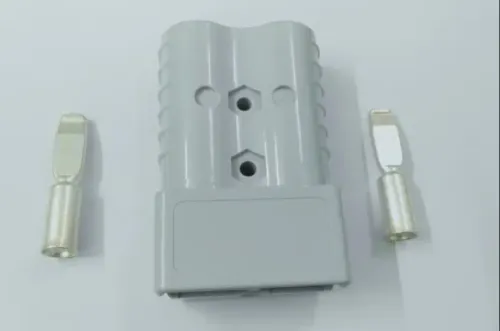
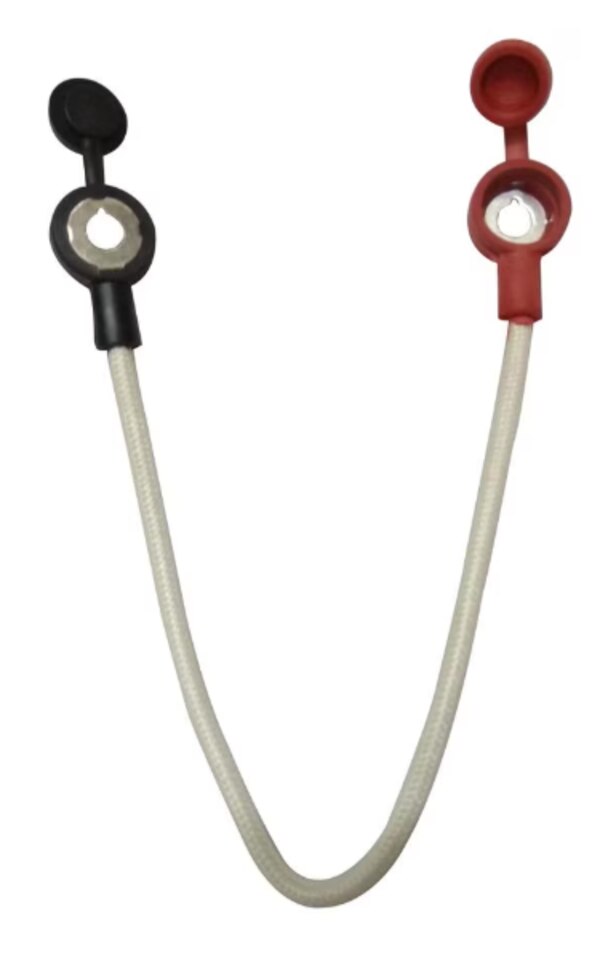
A series cable joins the positive terminal of one battery to the negative terminal of the next, so every inter-battery link carries the pack’s full traction current. Before ordering, you will be able to map 48 V and 60 V packs, define measurable cable specifications, check terminals and safety requirements, and compare supplier quotations without relying on vague terms such as “heavy-duty wire.”
Key takeaways
- Use three series links for four 12 V batteries in a 48 V pack.
- Put conductor size, insulation rating, length, lug holes, and crimp requirements on the purchase order.
- Check voltage drop and fault-current protection before approving the cable design.
- Inspect lug alignment, crimp quality, labels, and continuity when the shipment arrives.
Map the Battery Series Cable Across a 48 V or 60 V Pack
A 48 V pack made from four 12 V batteries uses three inter-battery series links. Connect the positive terminal of Battery 1 to the negative terminal of Battery 2, then Battery 2 positive to Battery 3 negative, and Battery 3 positive to Battery 4 negative. The remaining free terminals become the pack outputs.
| Pack | Series connections | Vehicle and charger leads |
|---|---|---|
| 48 V, four 12 V batteries | B1+ to B2−; B2+ to B3−; B3+ to B4− | Controller negative and charger negative to B1−; controller positive and charger positive to B4+ |
| 60 V, five 12 V batteries | B1+ to B2−; B2+ to B3−; B3+ to B4−; B4+ to B5− | Controller negative and charger negative to B1−; controller positive and charger positive to B5+ |
The e rickshaw battery series cable belongs only between adjacent batteries. Do not attach a vehicle lead to an intermediate junction; that bypasses part of the pack and can damage batteries or the controller.
The battery series wire for ev assembly carries the same traction current as the controller input cable, not merely the charger’s lower charging current.
Before ordering, mark each finished link by direction or color and match its length to the terminal spacing. Reversed polarity at the final connection can destroy the controller immediately. Route the links so a loose cable or tool cannot bridge adjacent terminals.
Put Measurable Cable Specifications on the Purchase Order
“Heavy-duty wire” is not a purchase specification. Require battery series wire specifications on the order, together with an approved sample or drawing showing the finished assembly.
- Conductor: state copper or another named material, cross-sectional area in mm², strand construction, and resistance limit or test method.
- Insulation: state material, wall thickness or outside diameter, temperature rating, and voltage rating based on maximum pack voltage, not only nominal 48 V or 60 V.
- Length: state total finished length and centre-to-centre terminal spacing, each with millimetre tolerances; show lug orientation and terminal-hole diameter.
- Marking: state positive and negative colour or polarity marking, part number, batch number, and any required end identification.
- Environment: state operating-temperature range and compatibility with abrasion, humidity, oil, and battery electrolyte.
- Assembly control: state terminal type, barrel size, crimp method, crimp-height limit, and the continuity and polarity test procedure.
| Detail | Acceptable order entry | Unsafe wording |
|---|---|---|
| Conductor | 16 mm² stranded copper; resistance limit recorded | Heavy-duty wire |
| Insulation | Named material with temperature and voltage ratings | Standard insulation |
| Length | Finished dimension with tolerance | One-metre lead |
| Marking | Polarity, part number, and batch identification | Red and black |
| Drawing | Lug spacing, orientation, and finished length | As per sample |
Require the supplier to obtain drawing approval before production. This prevents “battery series cable” from becoming an arbitrary ready-made lead that fits one batch but not the next.
Size the Link for Current, Voltage Drop, and Fault Conditions
A 48 V pack made from four 12 V batteries sends the same traction current through each series link as through the controller input cable. Charger current is lower, so using it as the cable’s primary rating can leave the link undersized during acceleration, hill climbing, or regenerative braking.
Start with the vehicle’s measured current profile: continuous operating current, peak current, peak duration, and duty cycle. Select the conductor from that profile, then confirm the supplier’s ampacity figure states ambient temperature, insulation temperature, bundling, enclosure, airflow, and installation position. Cross-sectional area alone does not prove current capacity.
Verify voltage drop rather than trusting a nominal gauge. Calculate Vdrop = I × R for the complete lead, including both terminals and crimps, at the highest expected operating current.
Measure finished-lead resistance with a four-wire milliohm test, or perform a loaded test and record voltage at both ends; excessive drop wastes power and reduces controller voltage.
Request evidence tied to the exact battery series wire for ev assembly:
- Resistance of a finished lead at a stated temperature and length
- Continuous and short-duration current ratings with test conditions
- Voltage-drop result at your specified current
- Temperature rise after the required duty cycle
- Crimp pull-test or resistance records from the same production batch
Treat fault current separately. Place a fuse close to the source, keep unfused conductor length short, and choose an interrupt rating above the battery’s prospective short-circuit current. Route the link so a loose lead or tool cannot bridge adjacent terminals.
Specify Lugs, Crimps, Assembly Format, and Incoming Checks
A cable can have enough copper and still fail assembly: the lug hole may not fit the battery stud, the barrel may not accept the strand bundle, or the lug may strike the case. Specify the terminal before ordering, not after the e rickshaw battery series cable arrives.
Your battery series wire specifications should identify:
- Lug hole diameter, barrel entry range, terminal material, and stud compatibility
- Conductor cross-sectional area, strand class, and approved crimp tooling
- Total finished length, center-to-center terminal spacing, and lug orientation
- Polarity marking or color coding at both ends
- Insulation clearance around each lug and the required bend direction
- Crimp method, crimp height limit, and pull-test requirement
- Continuity and polarity test procedure for each finished assembly
Request a dimensioned sample or drawing. It must show the lug faces, barrel dimensions, overall length, and spacing between terminal centers; “standard lead” leaves too much room for a supplier’s interpretation.
At receiving, check every lot against the approved drawing:
- Measure finished length, lug-hole diameter, barrel dimensions, and conductor resistance.
- Confirm positive-to-negative polarity and inspect insulation for cuts, compression damage, or exposed strands.
- Verify crimp height and pull strength against the terminal manufacturer’s limits.
- Flex the cable near each lug and reject cracked insulation, loose strands, or a lug that rotates.
A low-resistance continuity reading proves only that metal connects. It will not expose a weak crimp that opens during vibration or heating. Reject solder-only lugs where solder wicks into the flexible cable and creates a rigid fatigue point.
Compare a Battery Series Wire Supplier Near Delhi by Delivered Quality
Before approving an order, ask a battery for series wire details supplier in Delhi for one production sample and a controlled drawing, not a catalogue description.
The drawing must show finished length, centre-to-centre terminal spacing, lug orientation, polarity marking, conductor area in mm², insulation temperature and voltage ratings, crimp method, and the continuity and polarity test procedure.
| Supplier evidence | Accept | Reject |
|---|---|---|
| Delivered resistance | Measured value per finished lead, with test current and lead length | “Low resistance” with no figure |
| Terminal consistency | Sample measurements for hole diameter, spacing, orientation, and crimp pull-test result | Visual inspection only |
| Conductor specification | Material, strand construction, and cross-sectional area recorded | “Heavy-duty wire” or nominal gauge alone |
| Traceability | Batch number tied to wire, terminals, and inspection record | Unmarked replacement stock |
| Replacement control | Same drawing revision and test limits for the next batch | Supplier changes parts without approval |
Ask the battery series wire supplier near Delhi to identify the insulation temperature rating on the drawing and state how each lead is checked before dispatch. Request photographs of the first article beside a ruler and terminal gauge; they expose length and orientation errors quickly.
Digitech Sales is worth comparing on whether it supplies a documented sample and repeatable inspection record, not merely on the lowest price per lead. Approve only after the sample fits the battery posts, routes without rubbing, and passes your resistance, polarity, and crimp checks.
Related product
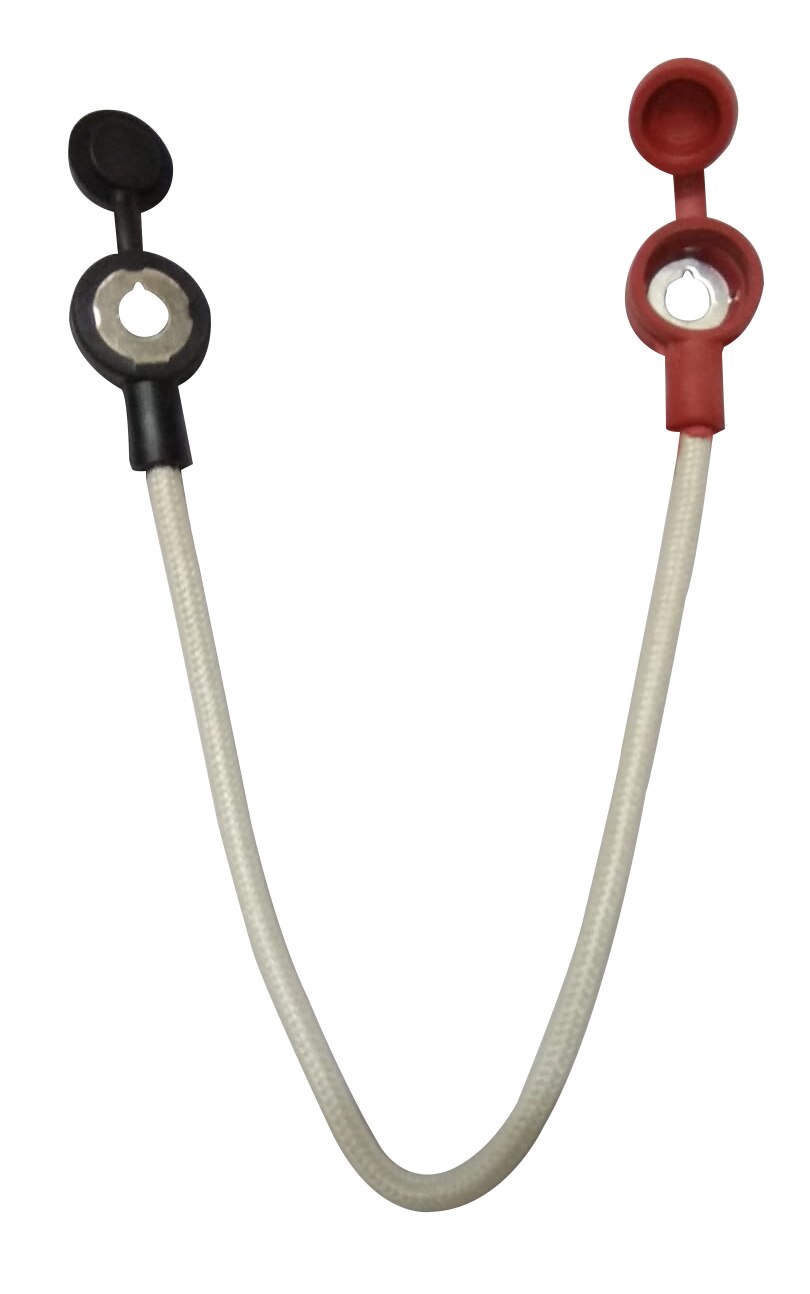 | BATTERY WIRE This is an EV lead acid battery connecting wire. ●Usage: Designed for establishing secure electrical connections between lead-acid battery terminals... View product → |
Frequently asked questions
How many series cables does a 48 V pack made from four 12 V batteries need?
It needs three inter-battery links: Battery 1 positive to Battery 2 negative, Battery 2 positive to Battery 3 negative, and Battery 3 positive to Battery 4 negative.
What battery series wire specifications belong on the purchase order?
State the conductor cross-section, cable length, insulation voltage and temperature ratings, lug hole size, terminal orientation, crimp method, labels, and required assembly format.
How do you size a battery series cable for an EV pack?
Check the pack's continuous and peak current, allowable voltage drop, cable length, heat exposure, short-circuit risk, and the protection provided by the battery and controller.
What should you check when battery series cables arrive?
Verify the quantity, measured length, conductor size, lug and hole dimensions, insulation condition, crimp compression, terminal alignment, labels, and continuity before installation.
Keywords